Expected Try (xT): putting a number on danger
In football, Expected Goals (xG) has become ubiquitous: every shot is assigned a probability of becoming a goal, based on position, angle, and action type. A shot from the penalty spot is worth ~0.76 xG. A header from a corner is worth ~0.05.
Rugby. Same problem, same question: how dangerous is this action for the defending team? A ruck at halfway is not the same as a linebreak 5 metres from the try line. A well-won lineout in the opposition 22 is not worth the same as a turnover after a wayward kick.
xT (Expected Try) answers that: what is the probability that the team in possession scores in the next 90 seconds, from this position, following this action?
We call it Expected Try — but it covers tries, penalties and drop goals. In football, xG counts one way to score. In rugby there are three, and ignoring penalties would mean underestimating danger in the opposition 22, where a ruck is just as likely to produce three points as five.
The data: 48 matches from the 2023 Rugby World Cup — 32,000+ events, 325 tries, 147 penalty goals.
1. The geography of danger
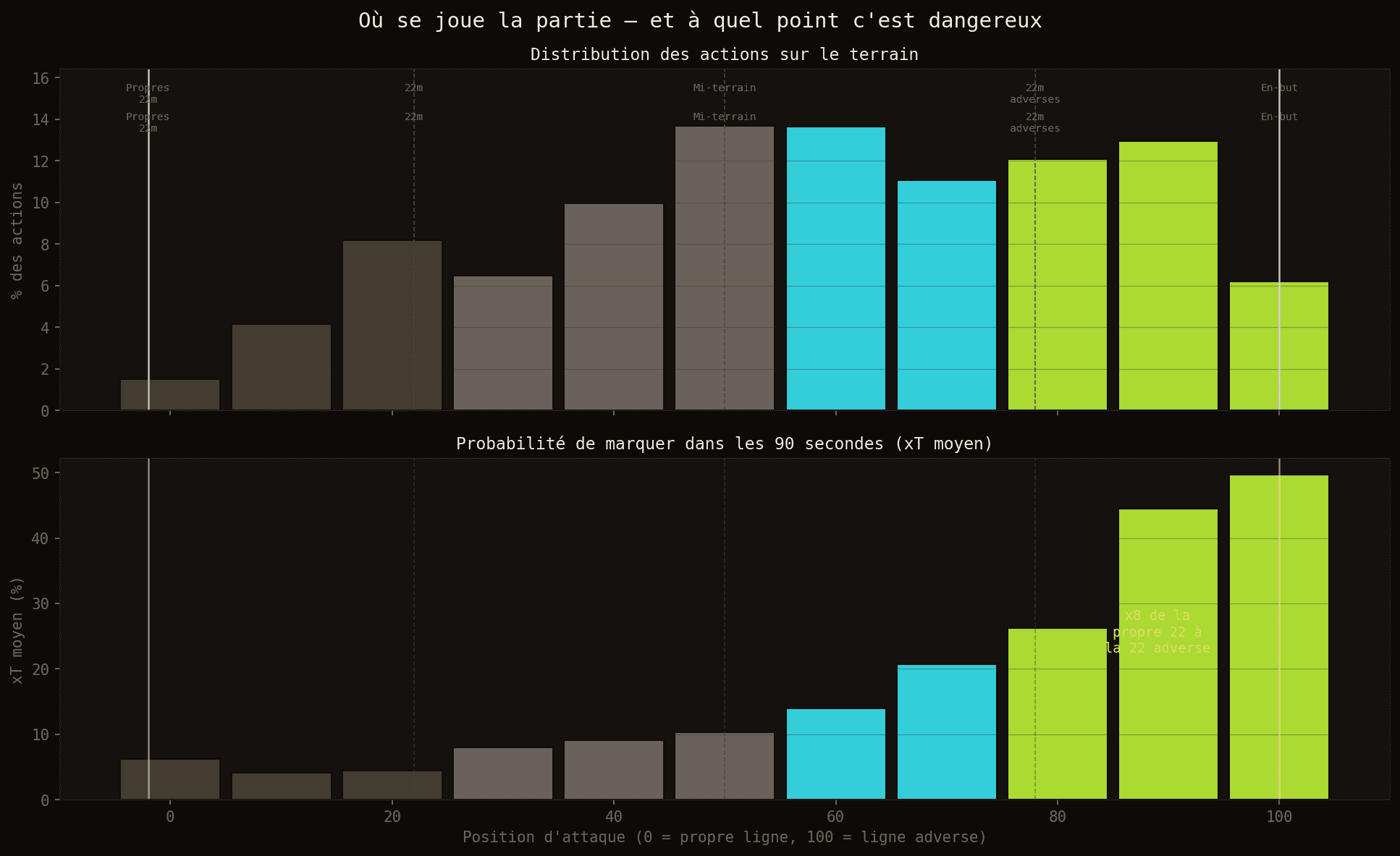
Top: distribution of all actions. Bottom: probability of scoring within 90s by zone.
The two charts don't tell the same story.
Half of all actions occur in the central zone — between the two 22-metre lines. That's where possession is contested, rucks won, scrums played. But xT climbs slowly through that zone: ~9% in the own half, ~16% in the opponent's half, reaching 20% just before the opposition 22 — still half the danger of actually crossing that line. All that possession work, for a fraction of the threat.
Meanwhile, the probability of scoring in the next 90 seconds rises from 4.3% in the own 22 to 40.7% in the opposition 22 — a 9.5× increase.
Having possession doesn't mean being dangerous. Having possession in the opposition 22 does.
2. The model
Features
9 input variables: longitudinal position on the pitch, distance from the pitch centre, distance to the opposition line, zone flags (in the opposition 22, in the opposition half), score differential, match progression, half indicator, and action type.
Model choice
Both models were evaluated with match-level cross-validation (GroupKFold, 5 folds): logistic regression achieves an AUC of 0.78, versus 0.75 for XGBoost. Logistic regression is chosen as the prediction model. XGBoost is kept in parallel solely for its feature importance chart, whose gain-based reading complements the logistic coefficients. All xT values shown in this article are computed by the logistic regression model.
Feature importance
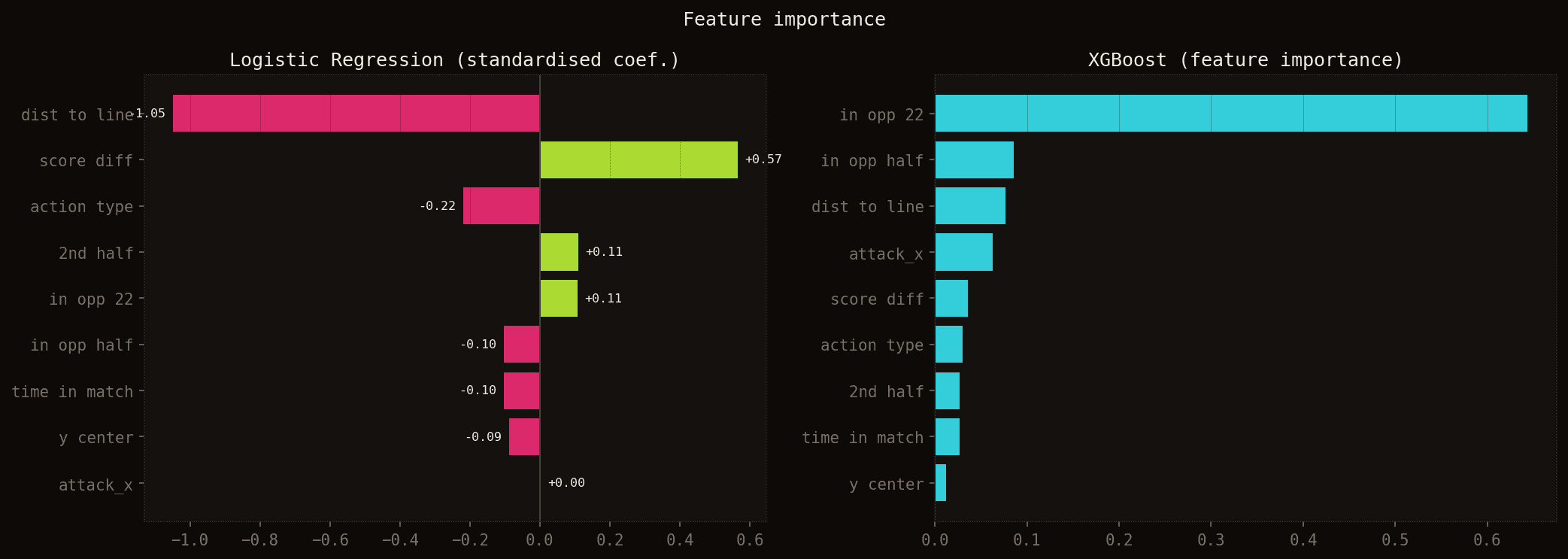
Logistic regression coefficients (left) and XGBoost feature importance (right).
Both models converge on the same conclusion.
In logistic regression (the chosen model), distance to the opposition try line dominates — every metre gained in the opposition half matters more.
In XGBoost (trained for comparison), a single variable dominates at 80% importance: crossing the opposition 22-metre line. The binary threshold and the logistic regression's continuous gradient tell the same story from two different angles.
Entering the opposition 22 is the boundary that changes everything.
3. The danger map
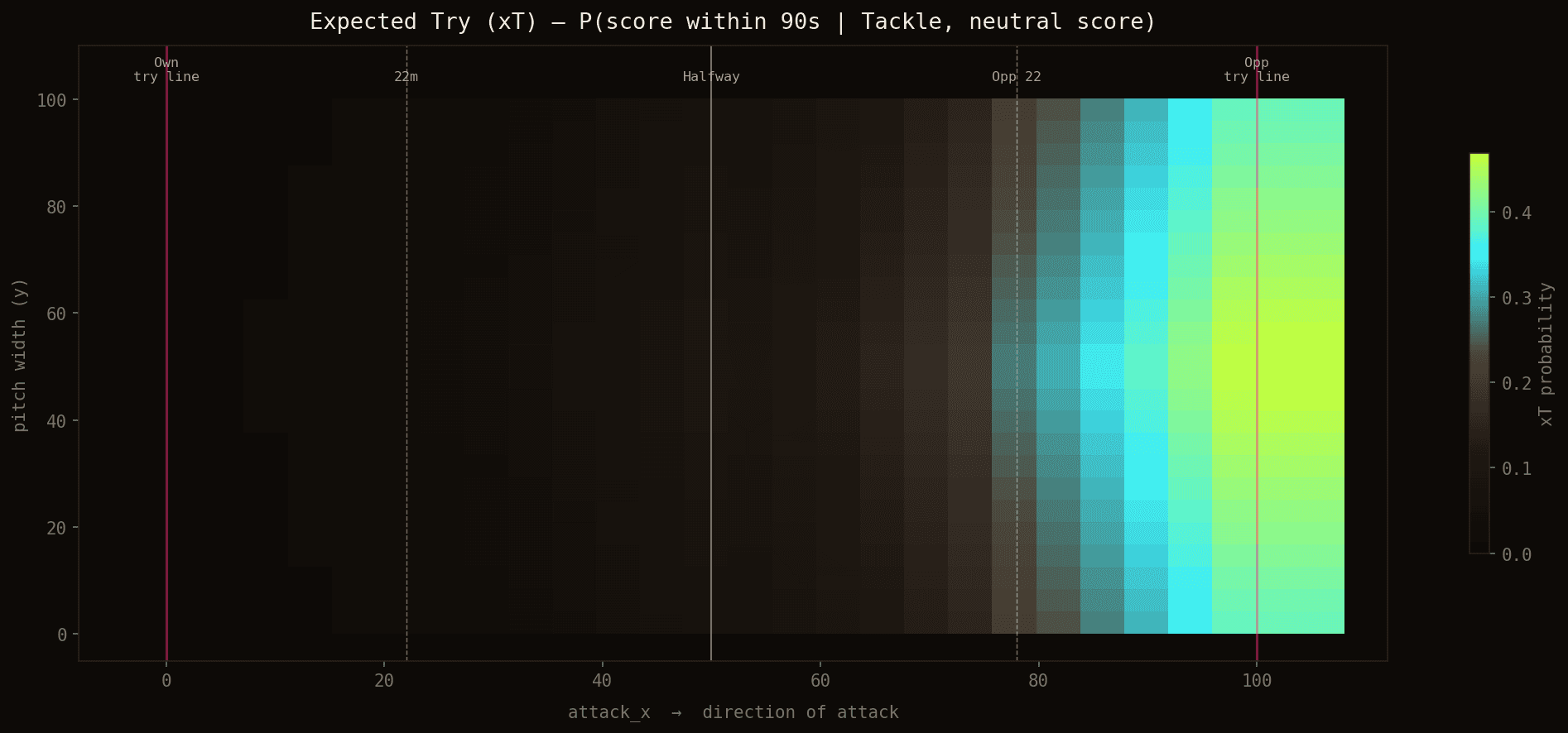
xT = P(score in 90s) for a standard ruck, neutral score, mid-match.
Probability climbs progressively to halfway, accelerates in the opposition half, and spikes beyond the 22. The gradient is clear and regular.
One notable detail: the centre of the pitch is slightly more dangerous than the wings at the same distance from the line. Central play preserves options in both directions.
4. Not all actions are equal
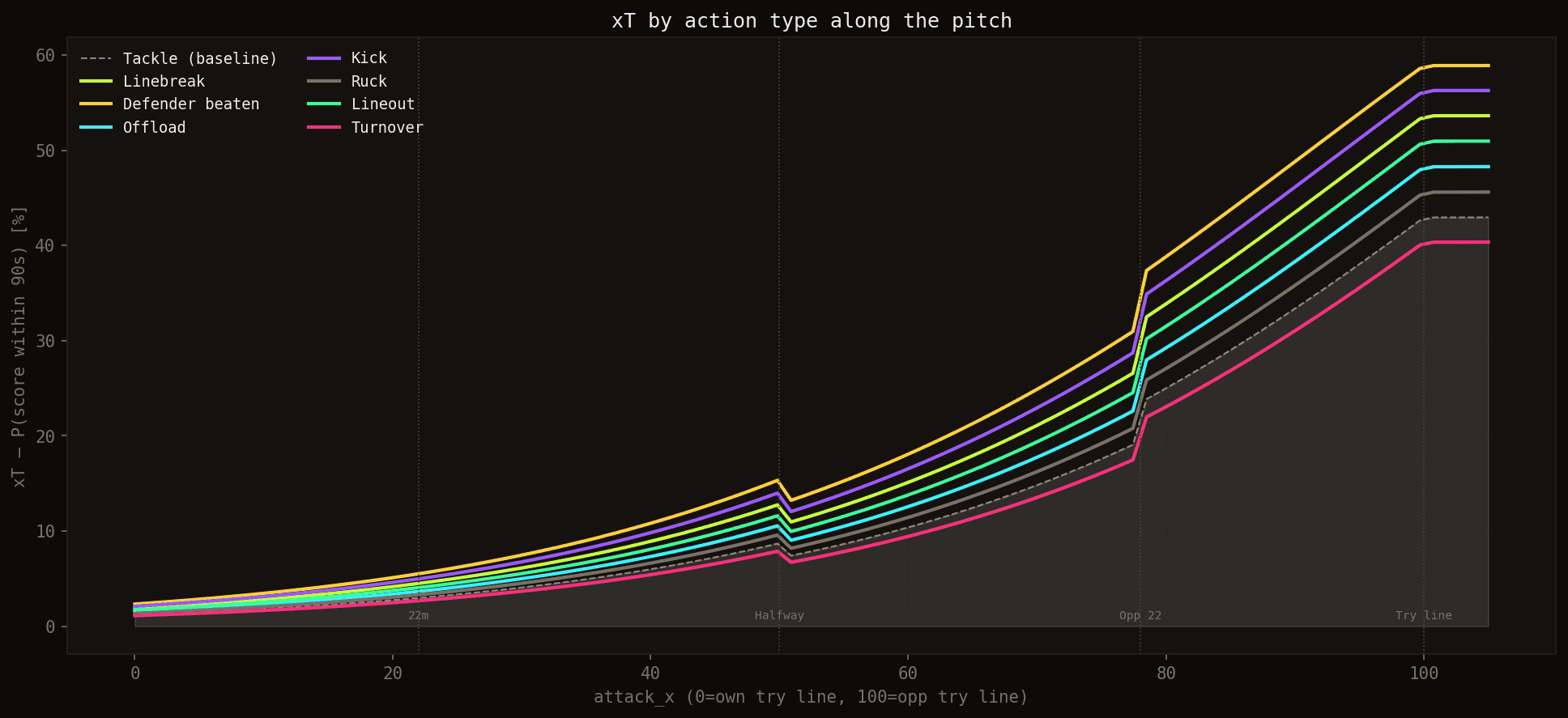
Average xT by action type along the pitch. Shaded area = baseline ruck.
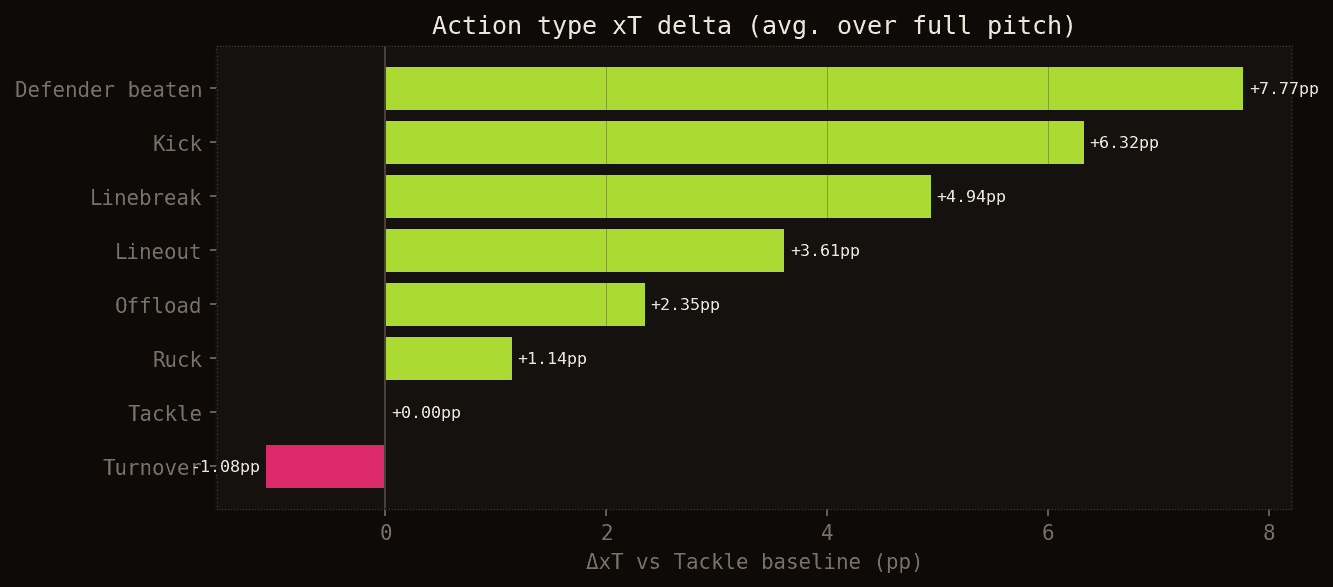
Average xT gain or loss relative to a ruck, across the full pitch.
| Action | Average xT | vs ruck |
|---|---|---|
| Linebreak | 22.4% | +10.3 pp |
| Defender beaten | 19.3% | +7.1 pp |
| Kick | 16.5% | +4.3 pp |
| Offload | 13.1% | +0.9 pp |
| Ruck | 11.7% | baseline |
| Turnover | 1.7% | −10.5 pp |
What stands out: a linebreak at halfway has the same xT as a ruck in the opposition 22. It isn't just a highlight — it's a teleporter into the danger zone. Conversely, a turnover doesn't just stop the attack — it almost instantly erases all accumulated threat.
5. Danger grows as the match progresses
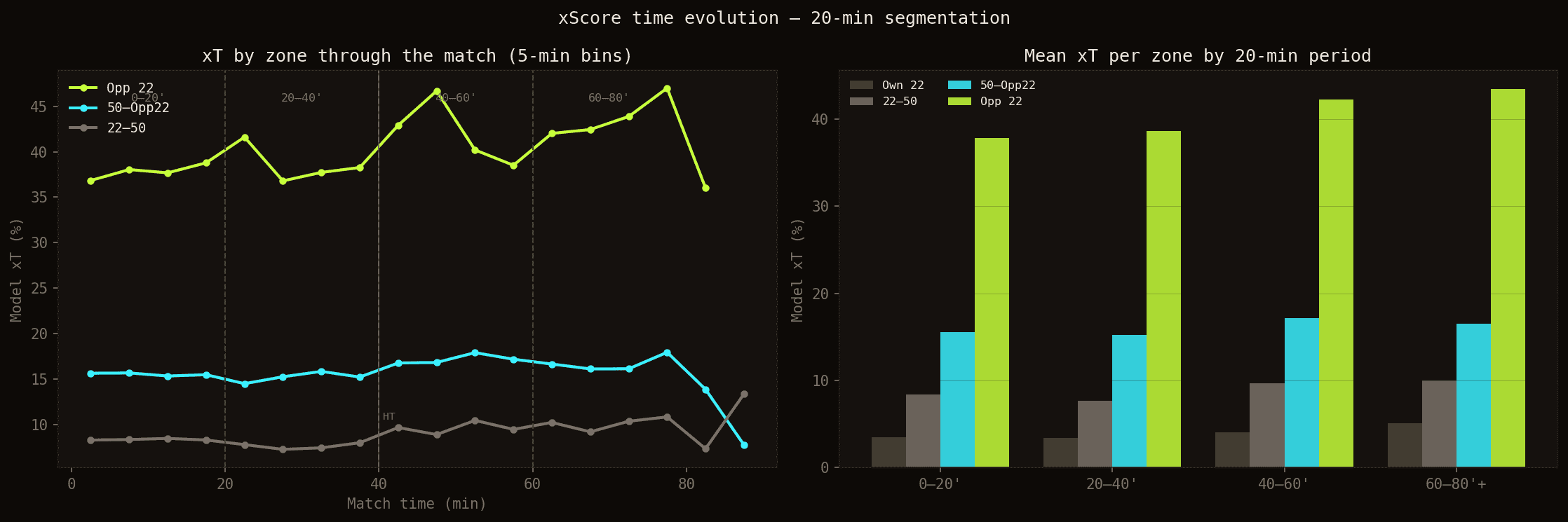
xT by zone in 5-minute bins (left) and by 20-minute period (right).
Scoring probability from the opposition 22 rises from 33.5% in the opening period to 47.4% in the final 20 minutes. Defences tire, teams force the issue — and the numbers show it.
What's useful is the quantification: a ruck in the opposition 22 at the 70th minute is worth 40% more than the same ruck at the 10th. The value of possession isn't fixed — it changes with time.
6. Which team created the most danger at the 2023 World Cup?
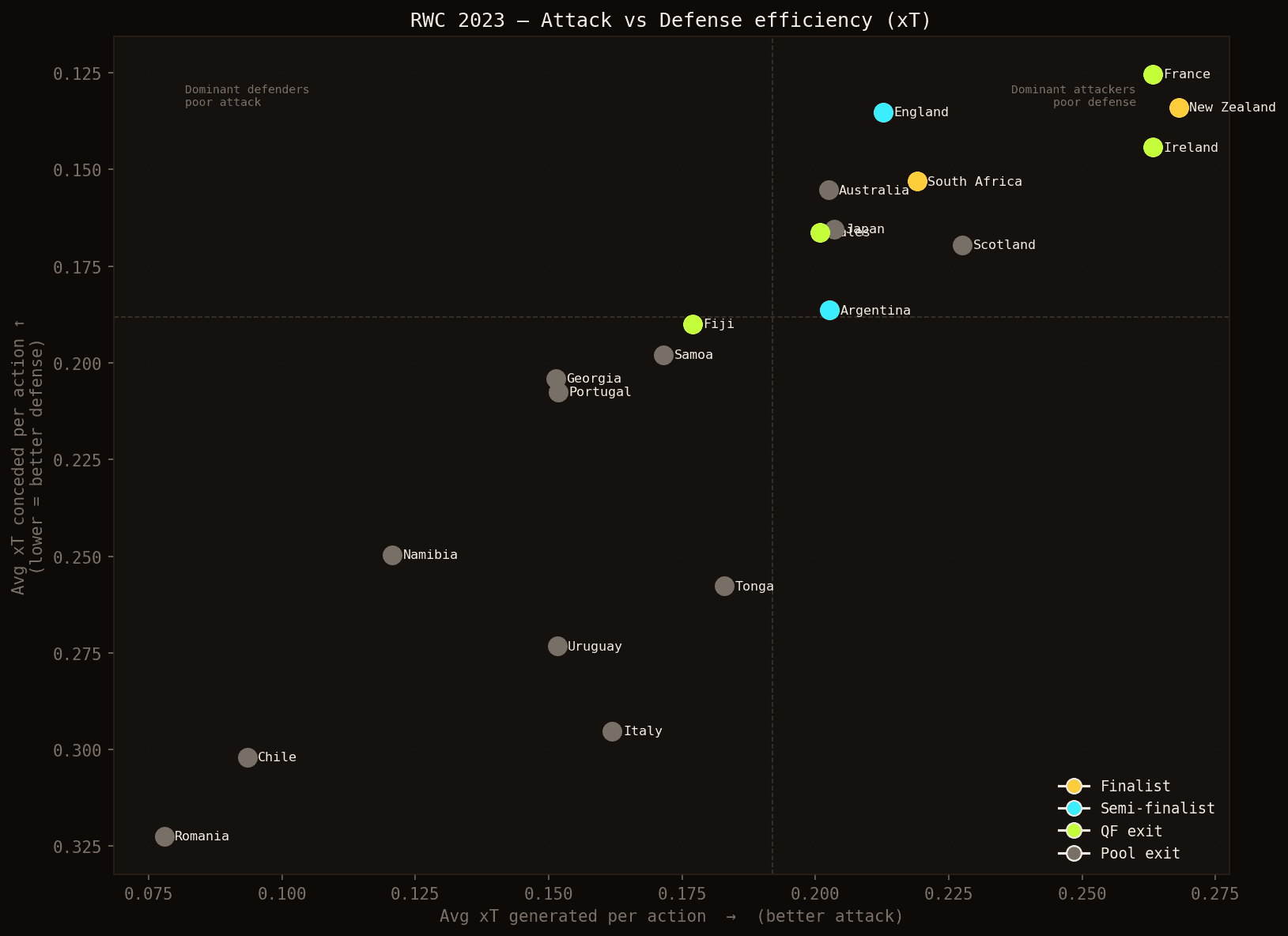
xT generated (attack) vs xT conceded (defence). Finalists in yellow, semi-finalists in blue, QF exits in green.
The chart reveals two contrasting philosophies.
France and New Zealand generated the most attacking danger, well clear of the rest of the tournament. Ireland completes the top three. These same teams also had the best defences.
South Africa won with a radically different approach: modest xT generated, iron-clad defence. The Springboks didn't try to dominate play — they tried not to concede. In the final against New Zealand, they won without scoring a single try.
The French paradox is striking: best attack and best defence in the tournament by xT — knocked out in the quarter-finals by South Africa. xT measures quality of play, not results. Rugby remains unpredictable.
The cumulative danger in that quarter-final makes it concrete:
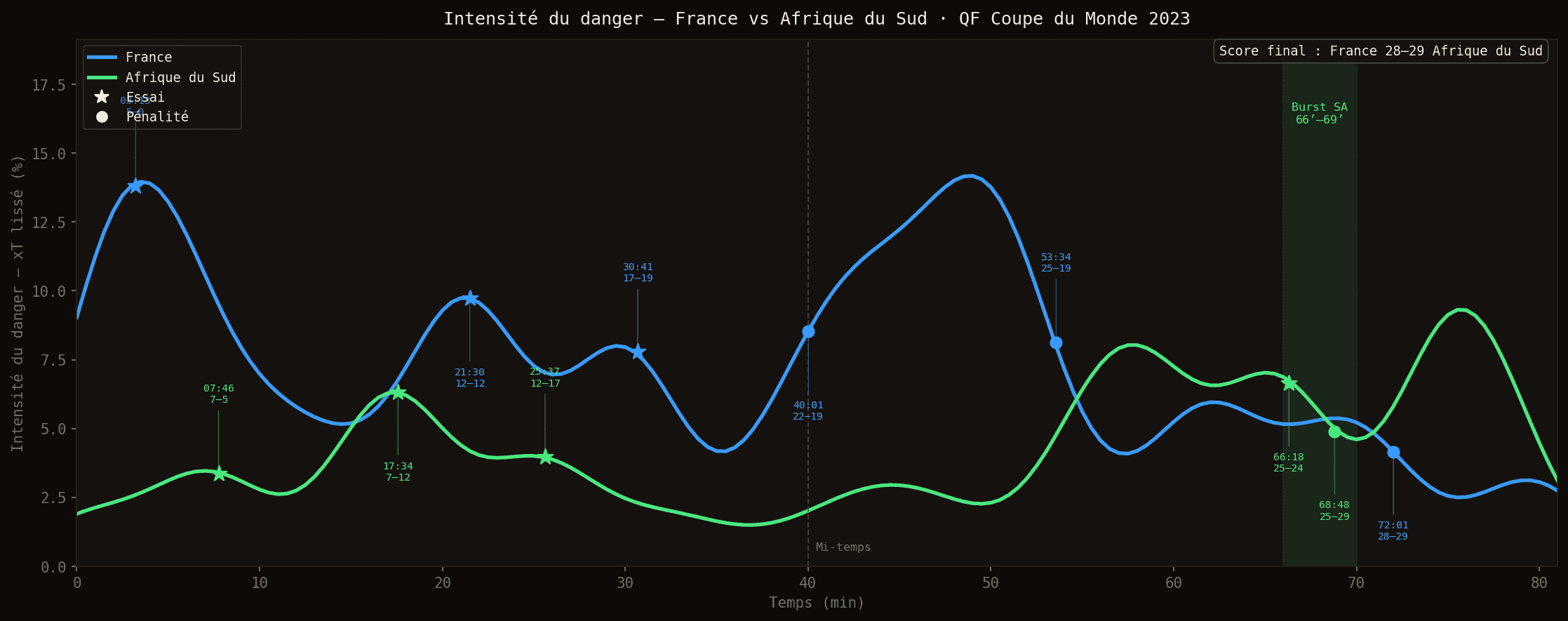
Smoothed danger intensity (rolling average xT). Star = try, dot = penalty.
The blue curve hovers between 7% and 15% throughout the match — France in sustained pressure. The green curve stays near the floor for 65 minutes (3–5%), then spikes in 3 minutes: try at 66', penalty at 69', 25–24 → 29–25. The match turns on a burst that the average intensity never saw coming.
France dominated intensity across 80 minutes. South Africa converted short, isolated attacking sequences. A try can come from a single action at 20% — the rest of the match is irrelevant.
7. What the model doesn't see
- Tempo: a ruck played in 4 seconds and one played in 12 have the same xT, but different tactical value
- Defensive density: the number of defenders between the ball and the line isn't in the model
- Set-piece specifics: a lineout 5 metres out or a dominant scrum deserve specific treatment
- Cross-competition transfer: this model is calibrated on the 2023 World Cup — TOP 14 and Pro D2 dynamics are different
- Data volume: 48 matches is enough to capture broad patterns, but too few to reliably model rare situations (tight late-game scenarios, highly mismatched teams)
xT turns every action into a comparable unit of danger. A linebreak at halfway is a 22% probability of scoring in the next 90 seconds. A turnover in the opposition 22 is a collapse to 1.7%. These numbers don't replace video analysis — they complement it, and let you compare situations that the eye can't calibrate on its own.